
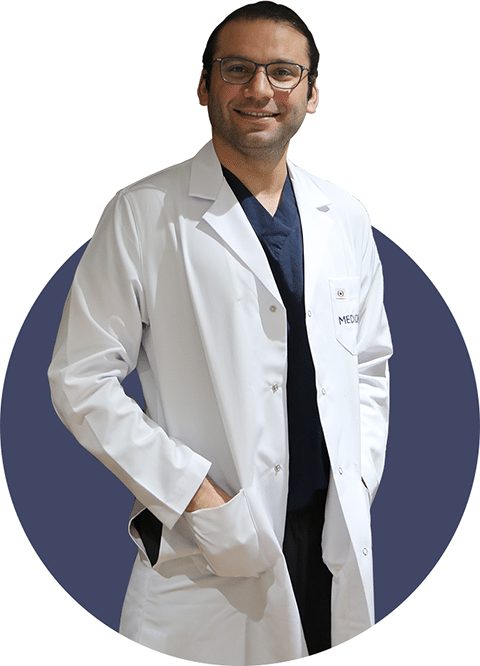
Yes — facelift in Turkey is safe when performed by a board-certified plastic surgeon in an accredited hospital. It is also not safe when performed by an unverified surgeon in an unaccredited facility. The same is true of facelift in the United States. The question is not about the country — it is about the specific surgeon and facility.
— Dr. Umut Zereyak
The direct answer
Facelift surgery is a major surgical procedure with real risks — regardless of where it is performed. Those risks include hematoma, nerve injury, infection, scarring, and anesthetic complications. A responsible answer to the question of safety acknowledges those risks rather than dismissing them.
What Turkey-specific medical tourism adds to this equation is a set of logistical variables — recovering far from home, flying during early recovery, follow-up care at a distance — that require management. These are not insurmountable, but they require planning and a practise structured to support international patients.
What Turkey-specific medical tourism does not add is lower surgical quality at accredited facilities with verified surgeons. The same deep plane technique — the same mandibular ligament release, the same nasolabial fold correction, the same sub-SMAS composite repositioning — at a JCI-accredited hospital, produces equivalent outcomes regardless of which country it is performed in.
How to verify safety before booking
Verify surgeon credentials independently
Do not rely on the surgeon's own website or patient testimonials. Check ISAPS membership at isaps.org — search the surgeon by name. Check the Turkish Ministry of Health physician registry at saglik.gov.tr. Both are publicly accessible and do not require any contact with the clinic.
Verify hospital accreditation
All surgery should be performed in a JCI-accredited hospital. Verify independently at jointcommissioninternational.org — enter the hospital name. JCI accreditation confirms patient safety standards equivalent to US hospital accreditation. Do not accept a clinic's word on this — check the JCI database directly.
Video consultation before any commitment
Any reputable surgeon will conduct a video consultation before you travel. Use this to assess communication quality, the surgeon's preparation (did they review your photographs beforehand?), and their willingness to give honest rather than promotional answers. If something feels rushed or scripted, that is a signal.
Ask specific questions about complications
Ask the surgeon directly: what is your hematoma rate? What happens if I develop a complication after I fly home? How do you manage post-operative problems at distance? A surgeon who gives vague or dismissive answers to these questions is not the right choice.
Understand the recovery logistics
Ask for a written protocol: minimum days before flying, what monitoring occurs, who is reachable if you have concerns at 3am in your hotel. A practise structured for international patients has clear answers to these questions.
Red flags: when NOT to proceed
- Surgeon cannot be found in the ISAPS directory — do not proceed
- Surgery offered at a non-hospital clinic without overnight monitoring capability
- No video consultation offered before travel commitment
- Price significantly below market — €3,000 or under for deep plane facelift is a warning sign
- Before/after photographs that appear digitally altered or do not show consistent patient identity
- Coordinator answers medical questions rather than referring to the surgeon
- Pressure to book quickly or claims of "limited slots"
- No written quote provided — price only discussed verbally
What happens if complications occur at home?
Most post-operative complications are minor and manageable remotely — questions about healing, swelling patterns, or scar management that can be assessed through photographs shared by email or video call.
If a more significant issue arises — a hematoma, wound dehiscence, or infection — your local physician manages it based on documentation from Dr. Zereyak's team. We provide full operative notes, post-operative instructions, and a direct contact protocol for any physician managing a complication after you return home.
The majority of complications that require intervention — primarily hematoma — occur within the first 24 hours of surgery, before discharge. This is why 1–2 nights hospital stay and 5–7 days in Istanbul are standard: to ensure the acute post-operative period is monitored before you travel.
References
- Rohrich RJ, Coberly DM, Fagien S, Stuzin JM. Current concepts in deep plane face-lifts. Plast Reconstr Surg. 2004;114(6):1457-1468.
- Stuzin JM. MOC-PSSM CME article: Face lifting. Plast Reconstr Surg. 2008;121(1 Suppl):1-19.
Further reading
- Deep plane facelift Turkey: technique and results →
- Turkey vs USA: Full deep plane facelift comparison →
- Verify Dr. Zereyak's credentials independently →
- Cost breakdown and what's included →
- SMAS anatomy: understanding facelift surgery →
Have specific safety questions?
Book a free video consultation and ask them directly. Dr. Zereyak will verify credentials, explain hospital safety standards, and answer any specific concern before you make any commitment.